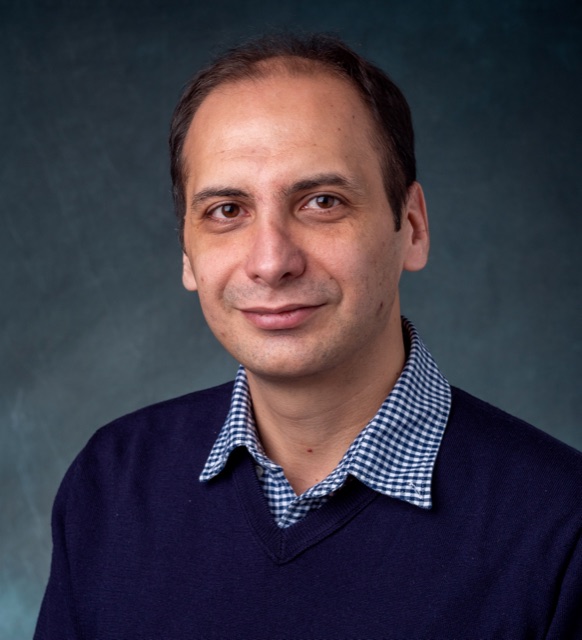
I build AI that respects the laws of physics.
Most real problems in science and engineering come with a few noisy measurements and a lot of known physics. My group builds neural networks that learn from data while obeying the equations behind fluids, materials, energy systems, and the human body.
I created Physics-Informed Neural Networks (PINNs), now a standard tool in scientific machine learning. The original paper has been cited more than 33,000 times (Google Scholar) and received the 2024 ICBS Frontiers of Science Award.
Prospective students and postdocs
I am recruiting PhD students and postdocs in scientific machine learning: physics-informed neural networks, AI agents for scientific simulation, and digital twins of physical systems.
Email me with the subject line "Prospective student" or "Prospective postdoc", your CV, and two or three sentences on a problem you would like to work on. PhD applicants should also apply to the UCR Mathematics PhD program.
Research now
- AI agents for scientific simulation. AI Lead on MAESTRO, a DOE Genesis Mission project on multi-agent AI for subsurface energy.
- Physics-informed models for power systems, subsurface energy, and cardiovascular blood flow.
- Self-learning models for robotic remanufacturing (NSF).
Supported by DOE, NSF, the University of California, and Procter & Gamble.
Selected work
Full list: Google Scholar.
Teaching
Applied Deep Learning, a free course with over 1 million views on YouTube and 3,500+ stars on GitHub. Short tutorials: deep learning, Gaussian processes, backpropagation.
Path
Recognition
- ICBS Frontiers of Science Award, 2024 (for the PINNs paper)
- Top-cited scientists, Stanford–Elsevier database (2026): #5 of 23,982 in Applied Mathematics (data)